Cryptographic Foundations of Payment Security
Cryptographic Foundations of Payment Security
Every time a payment moves through a system — whether it’s a chip card tapping a terminal, a wire transfer crossing SWIFT, or a Bitcoin transaction propagating through the mempool — cryptography is the mechanism that prevents anyone from stealing, forging, or replaying that payment. But the cryptographic requirements of payment systems are not the same as those of a typical web application.
In web security, you configure TLS, hash passwords with bcrypt, and move on. Payment cryptography operates under constraints that most developers never encounter: hardware security modules that physically destroy keys if tampered with, key derivation schemes that generate millions of unique encryption keys from a single master, and signature algorithms that must execute inside a chip with 32KB of memory.
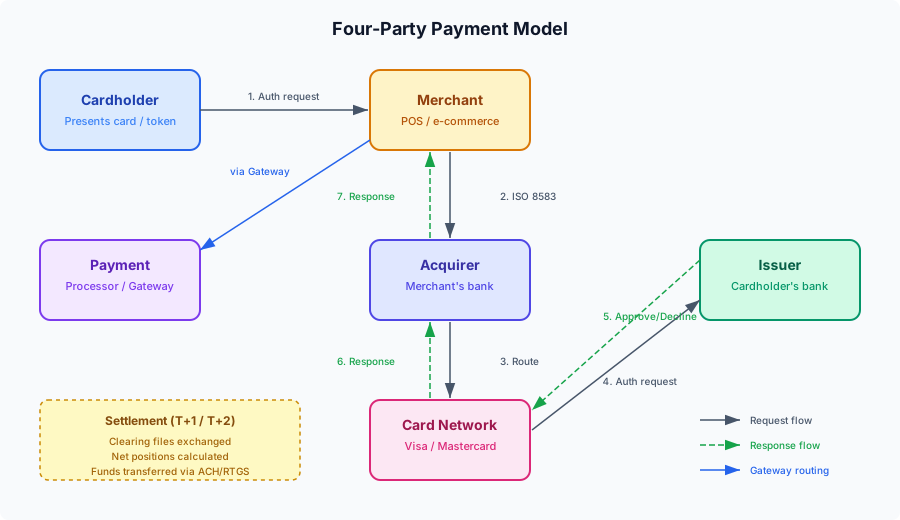
The diagram above shows the four-party model that structures most card-based payments globally. Every arrow in that diagram carries encrypted data, and the encryption at each hop serves a different purpose. The cardholder-to-merchant link protects card data in transit. The merchant-to-acquirer link carries an ISO 8583 message with encrypted PIN blocks. The acquirer-to-network link uses session keys derived from a master key hierarchy. And the network-to-issuer link carries the EMV cryptogram — a MAC generated by the card’s chip using a key that only the card and issuer share.
Symmetric Encryption in Payment Systems
Payment systems use symmetric encryption (AES, 3DES) far more heavily than you might expect. The reason is performance: a payment terminal processing a chip transaction has less than 500ms to complete the entire cryptographic exchange. Asymmetric operations like RSA-2048 take 10-50ms per operation on terminal hardware; symmetric operations complete in microseconds.
3DES: The Legacy That Won’t Die
Triple DES (3DES / TDEA) remains embedded in payment infrastructure because the EMV specification — governing billions of chip cards — was designed around it. The ARQC (Authorization Request Cryptogram) that every chip card generates uses 3DES-CBC-MAC:
from cryptography.hazmat.primitives.ciphers import Cipher, algorithms, modes
from cryptography.hazmat.backends import default_backend
import struct

def generate_arqc(icc_master_key: bytes, transaction_data: bytes) -> bytes:
    """
    Simplified ARQC generation using 3DES CBC-MAC.

    In production, the ICC Master Key is derived from the Issuer Master Key
    using card-specific data (PAN + PAN Sequence Number), and the session
    key is derived from the ICC Master Key using the Application Transaction
    Counter (ATC).

    Args:
        icc_master_key: 16-byte 3DES key stored on the chip
        transaction_data: Concatenated transaction fields (amount, currency,
                          date, terminal ID, ATC, etc.)
    Returns:
        8-byte ARQC cryptogram
    """
    # Pad transaction data to 8-byte boundary (ISO 9797-1 Method 2)
    padded = transaction_data + b'\x80'
    while len(padded) % 8 != 0:
        padded += b'\x00'

    # CBC-MAC with 3DES
    # First n-1 blocks: single DES with left half of key
    # Last block: full 3DES
    left_key = icc_master_key[:8]

    # Process all blocks with single DES first
    iv = b'\x00' * 8
    cipher = Cipher(algorithms.TripleDES(icc_master_key), modes.CBC(iv),
                    backend=default_backend())
    encryptor = cipher.encryptor()
    mac = encryptor.update(padded) + encryptor.finalize()

    # The MAC is the last 8 bytes of the CBC output
    return mac[-8:]
The critical detail: 3DES is not used because it’s the best algorithm available. It’s used because every EMV chip card on the planet has it burned into silicon, and replacing billions of cards is a multi-decade migration. AES-based EMV (referred to as AES-based ARQC in EMVCo’s newer specifications) is being deployed, but full transition won’t complete before 2030.
AES-256: Where New Payment Systems Build
Any payment system designed after 2010 should use AES-256. This includes:
- Token vault encryption: Storing PAN-to-token mappings (AES-256-GCM with authenticated encryption)
- PIN translation: Converting PIN blocks between encryption zones (AES key-wrapping per ANSI X9.24)
- Database field-level encryption: Encrypting sensitive fields at rest in payment databases
from cryptography.hazmat.primitives.ciphers.aead import AESGCM
import os

class PaymentFieldEncryptor:
    """
    AES-256-GCM encryption for sensitive payment fields.

    GCM provides both confidentiality and integrity — if the ciphertext
    or associated data is modified, decryption fails. This prevents
    an attacker from flipping bits in encrypted PANs.
    """

    def __init__(self, key: bytes):
        if len(key) != 32:
            raise ValueError("AES-256 requires a 32-byte key")
        self._aesgcm = AESGCM(key)

    def encrypt_pan(self, pan: str, merchant_id: str) -> bytes:
        """
        Encrypt a PAN with merchant_id as associated data (AAD).

        The AAD binds the ciphertext to a specific merchant context.
        Decrypting with a different merchant_id will fail, even with
        the correct key. This prevents cross-merchant PAN theft.
        """
        nonce = os.urandom(12)  # 96-bit nonce, NEVER reuse with same key
        ciphertext = self._aesgcm.encrypt(
            nonce,
            pan.encode('ascii'),
            merchant_id.encode('ascii')  # Associated data
        )
        return nonce + ciphertext  # Prepend nonce for decryption

    def decrypt_pan(self, encrypted: bytes, merchant_id: str) -> str:
        nonce = encrypted[:12]
        ciphertext = encrypted[12:]
        plaintext = self._aesgcm.decrypt(
            nonce,
            ciphertext,
            merchant_id.encode('ascii')
        )
        return plaintext.decode('ascii')
The use of GCM mode (Galois/Counter Mode) is non-negotiable for payment data. ECB mode would leak patterns in PANs (the first 6 digits are the BIN, which repeats across all cards from the same issuer). CBC mode provides confidentiality but not integrity — an attacker could flip bits in the ciphertext. GCM provides both, and the authentication tag catches any tampering.
Asymmetric Cryptography: RSA and ECDSA
Asymmetric cryptography in payments serves two purposes: authentication (proving identity) and key exchange (securely distributing symmetric keys).
RSA in EMV Card Authentication
Every EMV chip card carries an RSA key pair for offline data authentication. The payment network (Visa, Mastercard) operates as a Certificate Authority with a hierarchy:
- CA Public Key (the network’s root key, stored in every terminal)
- Issuer Public Key Certificate (signed by the CA)
- ICC Public Key Certificate (signed by the issuer)
When a terminal reads a chip card, it verifies this certificate chain to confirm the card was issued by a legitimate bank. The card then uses its private key to sign dynamic transaction data, proving it’s not a clone.
from cryptography.hazmat.primitives.asymmetric import rsa, padding
from cryptography.hazmat.primitives import hashes, serialization

def verify_emv_certificate_chain(
    ca_public_key: rsa.RSAPublicKey,
    issuer_cert_data: bytes,
    icc_cert_data: bytes,
    dynamic_data: bytes,
    icc_signature: bytes
) -> bool:
    """
    Verify the EMV offline data authentication chain.

    This implements the Static Data Authentication (SDA) and
    Dynamic Data Authentication (DDA) verification flow.

    In production, the certificate recovery process is more complex:
    EMV uses RSA recovery (not standard PKCS#1 signing) where the
    certificate IS the encrypted data, and you recover the payload
    by "decrypting" with the CA public key.
    """
    try:
        # Step 1: Recover issuer public key from issuer certificate
        # (In EMV, "verify" means RSA public key recovery of the cert payload)
        ca_public_key.verify(
            issuer_cert_data,  # This is actually the "signature"
            icc_cert_data,     # Signed data
            padding.PKCS1v15(),
            hashes.SHA1()      # EMV still uses SHA-1 for legacy compatibility
        )

        # Step 2: Verify ICC certificate with recovered issuer key
        # Step 3: Verify dynamic signature with recovered ICC key
        # (Simplified — actual EMV recovery is byte-level parsing)

        return True
    except Exception:
        return False
Note the use of SHA-1 — EMV specifications still reference SHA-1 because changing the hash algorithm requires updating every terminal and card on the planet. This is a known weakness, and newer EMV specifications support SHA-256, but migration is ongoing.
ECDSA in Blockchain Payments
Bitcoin and Ethereum use ECDSA (Elliptic Curve Digital Signature Algorithm) on the secp256k1 curve. This curve was an unusual choice — most TLS implementations use P-256 (secp256r1) — but Satoshi Nakamoto chose secp256k1 because its parameters are deterministic (not generated by NIST, avoiding potential backdoor concerns) and it’s slightly faster for verification.
from ecdsa import SigningKey, SECP256k1, BadSignatureError
import hashlib

def sign_bitcoin_transaction(private_key_hex: str, transaction_hash: bytes) -> bytes:
    """
    Sign a Bitcoin transaction using ECDSA on secp256k1.

    The transaction_hash is the double-SHA256 of the serialized
    transaction with the scriptPubKey of the input being spent
    inserted into the scriptSig field.
    """
    sk = SigningKey.from_string(
        bytes.fromhex(private_key_hex),
        curve=SECP256k1
    )
    # Bitcoin uses RFC 6979 deterministic k-value to prevent
    # nonce reuse attacks (the PlayStation 3 ECDSA break)
    signature = sk.sign_deterministic(
        transaction_hash,
        hashfunc=hashlib.sha256
    )
    return signature

def verify_transaction_signature(
    public_key_bytes: bytes,
    signature: bytes,
    transaction_hash: bytes
) -> bool:
    """
    Verify a Bitcoin transaction signature.

    Every full node performs this verification for every transaction
    in every block. secp256k1 verification takes ~0.1ms on modern
    hardware, which matters when verifying thousands of transactions
    per block.
    """
    from ecdsa import VerifyingKey
    try:
        vk = VerifyingKey.from_string(public_key_bytes, curve=SECP256k1)
        return vk.verify(signature, transaction_hash, hashfunc=hashlib.sha256)
    except BadSignatureError:
        return False
A critical security lesson from payment cryptography: in 2010, a developer reused the same random nonce k when generating ECDSA signatures for the PlayStation 3 code signing key. This allowed attackers to recover Sony’s private key entirely. Bitcoin avoids this with RFC 6979, which derives k deterministically from the private key and message — making nonce reuse impossible.
Hash Functions and Message Authentication Codes
Hash functions in payment systems serve three distinct roles:
- Integrity verification: SHA-256 hashes confirm that transaction data hasn’t been modified in transit
- Commitment: Hash(transaction) is published before the transaction details, creating a binding commitment
- Key derivation: HMAC-SHA256 derives session keys from master keys
PIN Block Encryption and ISO 9564
When a cardholder enters a PIN at a terminal, that PIN is never transmitted in cleartext. It’s encoded into a PIN block format (ISO 9564 Format 0, 1, 2, 3, or 4), XORed with the PAN, and encrypted:
def create_iso_format0_pin_block(pin: str, pan: str) -> bytes:
    """
    Create an ISO 9564 Format 0 PIN block.

    Format 0: PIN field XOR PAN field
    PIN field: 0x0 || PIN length || PIN digits || 0xF padding to 16 hex chars
    PAN field: 0x0000 || rightmost 12 digits of PAN (excluding check digit)
    """
    # Construct PIN field
    pin_field = f"0{len(pin)}{pin}"
    pin_field = pin_field.ljust(16, 'F')

    # Construct PAN field
    # Take rightmost 13 digits of PAN (including check digit),
    # then remove check digit = rightmost 12 digits excluding check
    pan_digits = pan[-13:-1]  # 12 digits, excluding check digit
    pan_field = f"0000{pan_digits}"

    # XOR the two fields
    pin_bytes = bytes.fromhex(pin_field)
    pan_bytes = bytes.fromhex(pan_field)

    return bytes(a ^ b for a, b in zip(pin_bytes, pan_bytes))
The XOR with the PAN is a binding mechanism: even if an attacker captures the encrypted PIN block and somehow decrypts it, they get PIN ⊕ PAN, not the raw PIN. Without knowing the PAN, the PIN remains protected. This is why PAN and PIN are always encrypted with different keys in payment systems — a compromise of one key doesn’t immediately compromise both values.
The Key Hierarchy Problem
The fundamental challenge in payment cryptography isn’t choosing algorithms — it’s managing keys. A single payment processor might manage millions of encryption keys: one per terminal, one per merchant, session keys that rotate per transaction, zone-specific keys for PIN translation between acquirer and network.
This is where Hardware Security Modules (HSMs) and key derivation schemes like DUKPT become essential — topics we’ll dissect in the next sections.
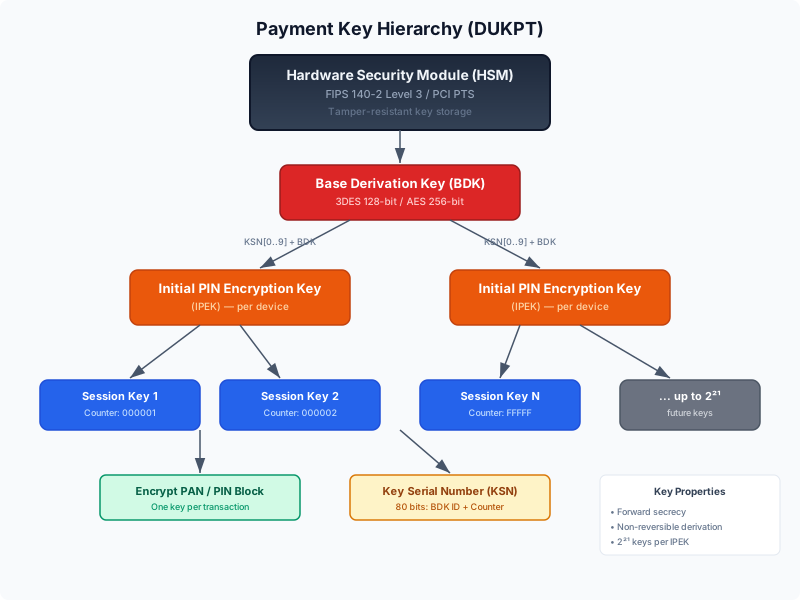
The diagram above shows the DUKPT (Derived Unique Key Per Transaction) hierarchy. A single Base Derivation Key (BDK) stored in an HSM generates up to 2²¹ unique session keys per terminal device. Each transaction uses a different key, and compromising one session key reveals nothing about the BDK or any other session key. The derivation is a one-way function — you cannot work backwards from a session key to the BDK.
This forward secrecy property is the reason DUKPT became the standard for PIN encryption in North American payment networks. If an attacker captures encrypted PIN blocks from a terminal, and later compromises that terminal’s current session key, they cannot decrypt previously captured transactions. The window of compromise is exactly one transaction.