Kotlin's Type System Unmasked
Kotlin’s Type System Unmasked
Java’s type system has a fracture running through its core. On one side: eight primitive types (int, double, boolean, …) that don’t participate in the object hierarchy, can’t be null, can’t be used as generic type arguments, and have no methods. On the other side: reference types rooted at java.lang.Object, fully nullable by default, carrying the constant threat of NullPointerException. And then there’s void — not a type at all, but a keyword that means “this method returns nothing,” except when you need it in generics, where you reach for the boxed Void class that can only hold null. This isn’t a type system. It’s two type systems bolted together with autoboxing tape.
Kotlin dismantled this and rebuilt it from the ground up.
The Unified Type Hierarchy
In Kotlin, every value is an object. There is no primitive/reference split at the language level. The type hierarchy has a clean structure:
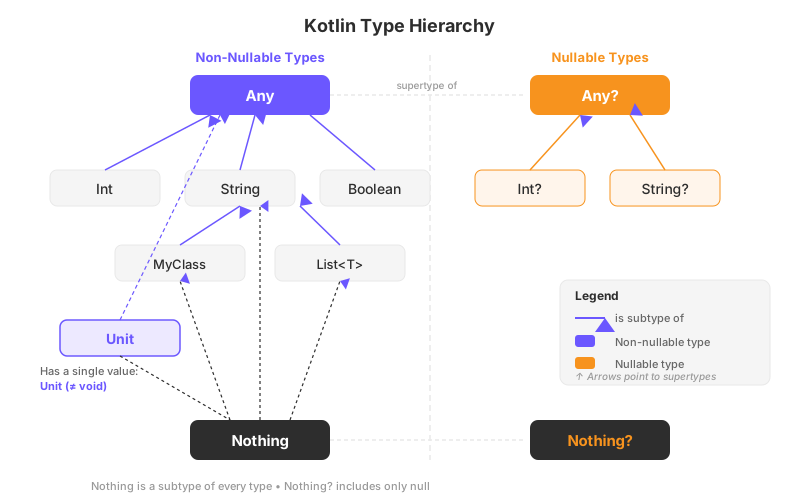
At the top sits Any — the root of all non-nullable types. Every class you write implicitly extends Any. Notice: not java.lang.Object. While Any maps to Object at the JVM bytecode level, it exposes a different API surface. Any declares exactly three methods: equals(), hashCode(), and toString(). The wait(), notify(), and getClass() clutter from Object is gone from the type system (though you can access them through casting when you need JVM interop).
fun demonstrate(value: Any) {
    // These three methods are available on Any
    println(value.toString())
    println(value.hashCode())
    println(value.equals(42))

    // To access Object-specific methods, cast explicitly
    val obj = value as java.lang.Object
    println(obj.javaClass)
}
At the bottom of the hierarchy sits Nothing — a type with zero instances. No value can ever have type Nothing. This sounds useless, but it’s the key that makes the type system internally consistent. A function that never returns (it always throws) has return type Nothing:
fun fail(message: String): Nothing {
    throw IllegalStateException(message)
}

// Why this matters: Nothing is a subtype of every type
val result: String = if (condition) computeValue() else fail("Missing value")
Because Nothing is a subtype of every type, the else branch type-checks against String. In Java, you’d have to write a helper that returns a generic T and suppress warnings, or restructure the code entirely.
Unit: The Type That void Should Have Been
Java’s void is a keyword, not a type. This creates real problems:
// Java: Can't use void in generics
interface Callback<T> {
    T execute();
}
// How do you implement a callback that returns nothing?
// Callback<void> — compilation error
// Callback<Void> — now you must return null
Callback<Void> noReturn = () -> { doSomething(); return null; }; // Ugly
Kotlin’s Unit is a real type with exactly one instance (also called Unit). Functions that don’t return a meaningful value return Unit:
fun greet(name: String): Unit {
    println("Hello, $name")
}

// The : Unit can be omitted — the compiler infers it
fun greet2(name: String) {
    println("Hello, $name")
}

// Unit works naturally in generics
interface Callback<T> {
    fun execute(): T
}

val noReturn = object : Callback<Unit> {
    override fun execute() {
        doSomething() // No awkward "return null" needed
    }
}
The compiler automatically inserts return Unit at the end of Unit-returning functions. At the bytecode level, Unit-returning functions compile to void methods in most cases — you pay zero runtime cost for this type-system cleanliness.
The Primitive Illusion
When you write val x: Int = 42 in Kotlin, the compiler decides the JVM representation based on nullability and usage context. Verify this yourself:
fun primitiveDemo() {
    val nonNull: Int = 42        // Compiles to: int
    val nullable: Int? = 42      // Compiles to: Integer
    val list: List<Int> = listOf(1, 2, 3)  // Uses Integer (generic context)
}
Compile and decompile to confirm:
kotlinc PrimitiveDemo.kt -include-runtime -d demo.jar
javap -c -p PrimitiveDemoKt.class
The bytecode reveals:
// nonNull → BIPUSH 42 (primitive int on stack)
// nullable → invokestatic Integer.valueOf(42) (boxed Integer)
This means you get the performance of primitives where it matters, with the expressiveness of objects everywhere. The compiler makes the decision — you express intent through the type system.
The Nullable Hierarchy: Any? Is the True Root
Here’s what most Kotlin tutorials gloss over: Any is not the ultimate root of the type hierarchy. Any? is.
Every non-nullable type T is a subtype of T?. This means Any? sits above Any, and the full hierarchy looks like this:
| Position | Type | Description |
|---|---|---|
| True root | Any? | Supertype of every type in Kotlin |
| Non-null root | Any | Supertype of all non-nullable types |
| True bottom | Nothing | Subtype of every non-nullable type |
| Null bottom | Nothing? | The type of the null literal itself |
Nothing? has exactly one value: null. The expression null in Kotlin has type Nothing?, which is a subtype of every nullable type. That’s why you can assign null to any T? variable — it’s subtype polymorphism, not special compiler magic.
val n: Nothing? = null
val s: String? = n      // Legal: Nothing? is a subtype of String?
val a: Any? = n          // Legal: Nothing? is a subtype of Any?
// val x: String = n     // Illegal: Nothing? is NOT a subtype of String
Smart Casts: The Compiler Proves Safety For You
In Java, instanceof checks and casts are separate operations, creating redundancy and room for error:
// Java: Check then cast — the cast is redundant
if (obj instanceof String) {
    String s = (String) obj;  // You already proved this. Why cast again?
    System.out.println(s.length());
}
Kotlin’s compiler tracks type information through control flow. After a type check, the variable is automatically cast:
fun process(obj: Any) {
    if (obj is String) {
        // obj is automatically cast to String here
        println(obj.length)  // No explicit cast needed
    }

    // Works with negation too
    if (obj !is String) return
    // From here, obj is String
    println(obj.uppercase())
}

// Works in when expressions
fun describe(obj: Any): String = when (obj) {
    is Int    -> "Integer: ${obj + 1}"         // obj is Int here
    is String -> "String of length ${obj.length}" // obj is String here
    is List<*> -> "List with ${obj.size} elements" // obj is List<*> here
    else      -> "Unknown"
}
Smart casts have limitations that reveal important compiler design decisions — but those are covered in the next section.
Java vs Kotlin Type System: Feature Comparison
| Feature | Java | Kotlin |
|---|---|---|
| Type hierarchy root | Object (reference types only) | Any (all types) |
| Primitives | 8 special types outside hierarchy | Compiler-managed, part of hierarchy |
| Null safety | All references nullable by default | Explicit via T vs T? |
| Void/Unit | void keyword, Void box class | Unit — real singleton type |
| Bottom type | None | Nothing — subtype of all types |
| Type checks + casts | instanceof + explicit cast | is + smart cast |
| Null type | Not expressible | Nothing? — type of null literal |
| Generics + void | Callback<Void> + return null | Callback<Unit> — no workaround needed |
What Comes Next
The unified type hierarchy and nullable/non-null split are the foundation. The next two sections go deeper into the mechanics that make this system work in practice:
Section 1: Null Safety Internals digs into how the compiler actually tracks nullability through control flow, what happens at the bytecode level when you use ?. and ?:, and the critical danger zone of Java interop through platform types.
Section 2: Variance, Reified Generics, and Type Projections tackles Kotlin’s approach to the generics problem — how declaration-site variance eliminates most of Java’s wildcard complexity, and how inline + reified works around JVM type erasure.