The Northeast Blackout: A Race Condition in an Alarm System
The Northeast Blackout: A Race Condition in an Alarm System and the Cascade That Left 55 Million People Without Power
The System as Its Engineers Understood It
The electrical grid in the northeastern United States and southeastern Canada is an interconnected system. Power flows across utility boundaries according to physical laws, not corporate contracts. When one utility’s generation drops, current flows in from neighboring utilities automatically. This interconnection is the grid’s greatest strength and its greatest vulnerability. It distributes load and provides resilience under normal conditions. Under failure conditions, it provides a propagation path.
FirstEnergy Corporation operates a portion of this grid in northern Ohio. Their energy management system is the GE XA/21, a supervisory control and data acquisition (SCADA) system that monitors thousands of sensors across the grid: line loads, generator outputs, transformer temperatures, breaker states. The XA/21 collects this data, displays it on operator consoles in the control room, and runs alarm logic that alerts operators when conditions exceed normal parameters.
The alarm system is the operator’s primary tool for situational awareness. When a transmission line trips, an alarm fires. When a transformer overheats, an alarm fires. When voltage at a bus drops below threshold, an alarm fires. The operator relies on alarms to distinguish between routine fluctuations and conditions that require intervention. Without alarms, the operator must manually scan thousands of data points on multiple display screens. This is not practical for a human on a normal day. It is not possible during a fast-moving cascade.
The XA/21 also runs a state estimator, a software model that computes the current state of the grid from sensor measurements and uses it to predict what will happen if a line or generator trips. Operators use the state estimator to evaluate contingencies: “If line X trips, will line Y overload?” This is contingency analysis, and it is the primary tool for preventing cascading failures.
On the afternoon of August 14, 2003, the XA/21 alarm and logging system at FirstEnergy’s control center has a software bug. The bug is a race condition in the alarm processing subsystem that causes the alarm system to stall under specific concurrent access patterns. When the stall occurs, the system continues to collect sensor data, but it stops processing alarm conditions and stops updating the operator’s alarm display. The operators see a frozen alarm screen. They do not know it is frozen. No meta-alarm exists to indicate that the alarm system itself has failed. The operators believe the system is functioning normally and that no alarms are firing because no alarm conditions exist.
This is the state of the system at approximately 14:14 Eastern Daylight Time on August 14, 2003.
The Chain
13:31 EDT. FirstEnergy’s Eastlake Unit 5 generating plant trips offline. This is a normal grid event. Generators trip regularly, and the grid is designed to absorb single-generator losses without consequence. The loss of Eastlake 5 reduces generation in the Cleveland area and increases load on transmission lines importing power from the south. This is expected.
14:14 EDT. The XA/21 alarm and logging system at FirstEnergy’s control center enters a stalled state due to the software race condition. From this moment forward, no alarms reach the operators. The state estimator also becomes unavailable because it depends on the same data processing pipeline. The operators have no automated situational awareness. They do not know this.
14:27 EDT. The Chamberlin-Harding 345kV transmission line sags into a tree and trips. Trees grow. Lines sag under load. Vegetation management, the process of trimming trees near power lines, is a known reliability requirement. FirstEnergy’s vegetation management program has fallen behind schedule in this corridor. The line trips, and the load it was carrying redistributes to adjacent lines. An alarm should fire on the operator’s console. It does not.
15:05 EDT. The Hanna-Juniper 345kV line sags into a tree and trips. The same mechanism: increased load, increased sag, tree contact. Two 345kV lines are now out. The load redistributes again. The remaining lines are now carrying more current than their normal rating. The operators are unaware.
15:32 EDT. The Star-South Canton 345kV line trips. Three major transmission lines are down. The control room operators at FirstEnergy are fielding phone calls from neighboring utilities asking about unusual power flows. The operators check their screens. The alarm display is quiet. The state estimator is unavailable, but the operators interpret the blank screen as “no problems.” A neighboring utility, American Electric Power (AEP), calls FirstEnergy to report that they are seeing unusual flows. FirstEnergy’s operators have no data to explain what AEP is seeing.
15:41 EDT. The Canton Central-Tidd 345kV line trips from overload. Four 345kV lines are down. The remaining transmission paths into Cleveland are severely overloaded. Voltage begins to collapse.
15:45:34 EDT. The cascade begins. Lines trip in rapid succession as each tripping line forces its load onto the remaining lines, which overload and trip in turn. The cascade propagates across Ohio, into Michigan, Pennsylvania, New York, and into Ontario, Canada. Over the next three to seven minutes, more than 500 generating units at 265 power plants shut down. 55 million people lose power.
15:46 to 16:13 EDT. The cascade is unstoppable by the time anyone understands what is happening. The grid separation occurs along boundaries that the system was not designed to support. Power is not restored to all affected areas for more than 24 hours. Some areas remain without power for several days.
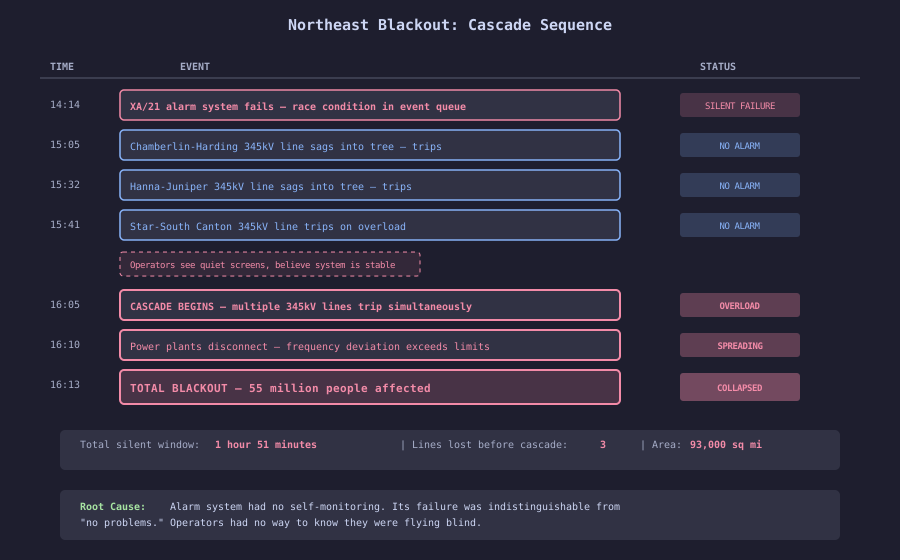
The diagram shows the critical period between 14:14 (when alarms stopped) and 15:45 (when the cascade became self-sustaining). During this 91-minute window, four 345kV transmission lines tripped sequentially. Any one of these trips, if detected and responded to by operators in time, could have been managed through load shedding or topology reconfiguration. The alarm system’s silence converted four manageable events into a catastrophic cascade.