The Calibrated Engineer
SummaryDefines the calibrated engineer — someone who knows...
Defines the calibrated engineer — someone who knows...
Defines the calibrated engineer — someone who knows what they don't know and how to learn it when needed — through the three-layer rule, a concrete debugging process, contrasts with the abstraction-dependent and systems-purist archetypes, the adapted T-shaped skill set, and a realistic day-in-the-life scenario.
What Calibration Means
A calibrated instrument gives accurate readings within its designed range and tells you clearly when it’s operating outside that range. A miscalibrated instrument gives confident readings that are wrong. The most dangerous instrument is the one that doesn’t tell you when it’s out of range — you trust its output, and you’re wrong, and you don’t know you’re wrong until something breaks.
Engineers work the same way.
A calibrated engineer is not someone who knows everything about every system. That person doesn’t exist, and chasing that ideal is a waste of finite time. A calibrated engineer is someone who knows what they know, knows what they don’t know, and knows how to learn the missing pieces when the situation demands it.
This is a fundamentally different posture from two common archetypes in the industry:
The abstraction-dependent engineer knows their framework and nothing else. They can build features quickly when the framework cooperates, but the moment something goes wrong at a lower layer — a network timeout, a database lock, a memory leak — they are stuck. They can’t diagnose the problem because they’ve never seen the layer where the problem lives. They file a ticket and wait for someone else to fix it. Their confidence in their own output is poorly calibrated: they believe they understand the system, but their understanding stops at a boundary they’ve never tested.
The systems purist knows how everything works from the transistor to the browser tab. They can explain the Linux boot process, the TCP state machine, the JVM’s garbage collector, and the browser’s rendering pipeline. They’re also six months behind on feature delivery because they insist on understanding every layer before using it. They rewrite standard library functions because they’re “not optimal.” They refuse to use managed services because they don’t trust abstractions they haven’t audited. Their understanding is deep but their output is narrow. They’ve optimized for knowledge instead of impact.
The calibrated engineer sits between these extremes. They use abstractions confidently but not blindly. They know enough about the layers below to debug common problems and recognize uncommon ones. They can distinguish between “this is acting weird because I misconfigured it” and “this is acting weird because of something in a layer I need to investigate.” That distinction — that calibration — is the core skill.
The Three-Layer Rule
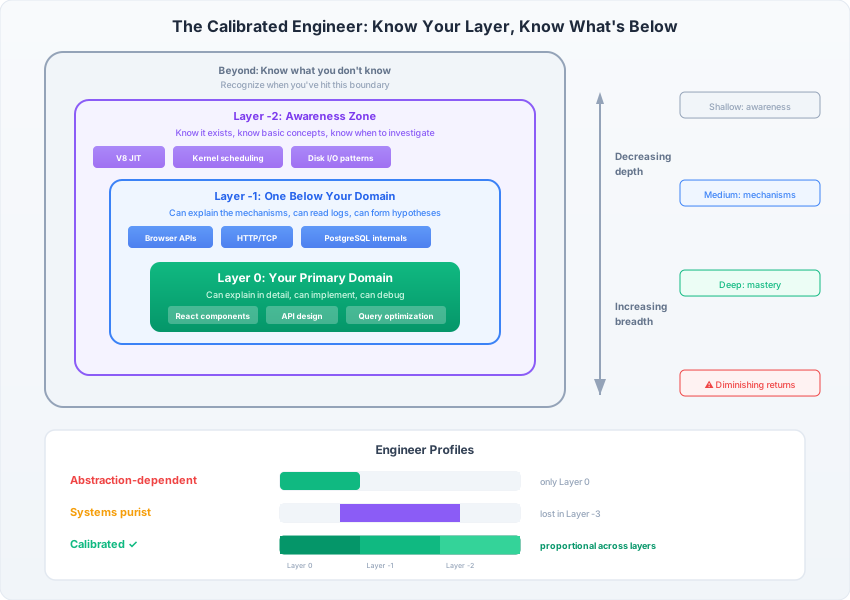
Here’s the mental model: at any given time, you should understand three layers of the system you’re working in.
Layer 0: Your working layer. This is the code you write every day. If you’re a web developer, this is your framework — React, Vue, Django, Rails. You should understand this layer deeply. You should know its API, its performance characteristics, its common pitfalls, and its internal architecture at a conceptual level. You should be able to explain why things work, not just how to make them work.
Layer -1: One layer below. This is the system your working layer is built on. For a React developer, this is the browser — the DOM, the event loop, the rendering pipeline, HTTP, and browser-provided APIs like fetch, localStorage, and requestAnimationFrame. You should understand this layer well enough to debug problems that originate here. When your React app is slow, you should be able to determine whether the bottleneck is in React’s reconciliation or in the browser’s rendering. When a network request fails, you should know how to read the browser’s network tab, understand CORS errors, and interpret HTTP status codes.
Layer -2: Two layers below. This is the infrastructure that Layer -1 sits on. For a React developer working through a browser, this is JavaScript engine internals (V8’s hidden classes, JIT compilation), TCP/IP networking, TLS, and operating system process scheduling. You don’t need deep expertise here. You need awareness. You should know these layers exist, know roughly what they do, and recognize when a problem might originate at this depth. If your network requests are slow and the server response time is fast, you should be able to hypothesize that the issue might be DNS resolution, TCP connection overhead, or TLS negotiation — even if you need to consult documentation or a colleague to go deeper.
Three layers is not arbitrary. It’s the practical boundary of useful understanding for most debugging scenarios. Problems that originate more than two layers below your working layer are rare and usually require a specialist. But problems that originate one or two layers below are common, and they’re exactly the problems that separate effective engineers from stuck ones.
The Debugging Process, Compared
Watch how three different engineers approach the same problem.
The problem: An API endpoint that usually responds in 50ms is sporadically taking 3 seconds. It happens about 5% of the time. No errors in the application logs. The endpoint queries a PostgreSQL database and returns a JSON response.
The abstraction-dependent engineer opens the monitoring dashboard, sees the latency spikes, and looks at the application code. The code looks correct. The queries are simple. They check the framework’s documentation for known issues. Nothing relevant. They try adding more logging. The logging shows that the delay happens during the database query, but only sometimes. They file a ticket with the DBA team: “Database is sometimes slow.” They wait.
The systems purist immediately opens a terminal, SSH-es into the database server, and starts inspecting. They check pg_stat_activity for lock contention, examine the query plan with EXPLAIN ANALYZE, review the PostgreSQL log for checkpoint activity, check the OS-level I/O stats with iostat, examine the filesystem cache hit ratio, and inspect the kernel’s memory pressure indicators. Forty-five minutes later, they’ve confirmed the problem is checkpoint-related I/O contention and have a comprehensive report. But they’ve spent their entire morning on a P3 issue, and the three P1 features they were supposed to ship are untouched.
The calibrated engineer starts at their working layer. Application code looks fine. They move one layer down: database. They run EXPLAIN ANALYZE on the query — it completes in 2ms consistently. So the query itself is fast. They check pg_stat_activity during a spike — no lock contention. They check the PostgreSQL log and notice the spikes correlate with checkpoint activity logged at LOG level. Hypothesis: the database’s periodic checkpoint is flushing dirty pages to disk, causing I/O contention that delays this query’s response. They verify by checking checkpoint timing configuration: checkpoint_timeout is set to the default 5 minutes, and the spikes occur at roughly 5-minute intervals. Resolution: adjust checkpoint_completion_target to spread the I/O load, or increase shared_buffers to reduce the frequency. Total time: fifteen minutes.
The calibrated engineer didn’t know the answer when they started. They had a process: identify the layer, apply knowledge of that layer, and if necessary, dive one layer deeper. They stopped when they found the root cause. They didn’t go deeper than necessary. They didn’t stay at the surface hoping someone else would fix it.
The T-Shaped Skill Set for Systems
The “T-shaped engineer” is a common concept: broad awareness across many domains, deep expertise in one. The calibrated engineer adapts this for the layer stack.
The horizontal bar of the T is layer awareness. You know the major layers exist — hardware, operating system, networking, runtime, framework, application. You can name the key concerns at each layer. You know that databases use indexes, that networks have latency, that operating systems schedule processes, that runtimes manage memory. This awareness is wide and shallow, but it’s not zero. It’s enough to generate hypotheses when something breaks.
The vertical bar of the T is layer depth in your domain. If you’re a backend engineer, the vertical bar extends through your application framework, down through the database engine, and into operating system I/O. You know these layers deeply. You can debug problems here without outside help. You can make architectural decisions informed by how these layers interact.
The crucial difference from the generic T-shaped model is that the horizontal bar isn’t just “other technologies” — it’s specifically the layers above and below your domain. A backend engineer’s horizontal bar isn’t “I also know some React.” It’s “I understand how the network layer delivers requests to my server, and I understand how the operating system allocates resources to my process.” This is structural awareness, not technology-tourism.
This means the calibrated engineer’s breadth is focused. It follows the stack, not the industry. You don’t need to know a little about every trending technology. You need to know a little about every layer your system sits on.
A Day in the Life
6:45 AM. You check the morning alerts on your phone. PagerDuty shows one resolved alert from overnight — a pod restart on the staging cluster. Not unusual; you’ll check the logs when you get to work but it doesn’t look production-impacting.
9:00 AM. You open your IDE and pick up the feature you’re building: a new endpoint that aggregates data from two microservices and returns a combined response. This is your working layer — application code. You write the endpoint, handle the two HTTP calls concurrently using asyncio.gather, parse the responses, merge the data, and return JSON. You write tests.
9:45 AM. The tests pass, but one of them is slower than you’d expect. The two HTTP calls should complete in parallel, but the test takes 400ms instead of the expected 200ms. You suspect they’re running sequentially despite gather. You add timing around each call and confirm: they’re concurrent, but one of the downstream services is slow. This isn’t a problem in your code — it’s a behavior of a system one layer out. You note it and move on. If the slowness persists in staging, you’ll investigate that service’s latency.
11:00 AM. A teammate pings you. They’re seeing an error they don’t understand: ConnectionResetError: [Errno 104] Connection reset by peer. They’ve Googled it, found Stack Overflow answers, and tried the suggestions (increase timeout, add retries). None have worked. They don’t know what “connection reset by peer” means at the protocol level.
You do. This is a layer below your application: TCP networking. A connection reset means the remote side sent a RST packet, which means it forcibly closed the connection. Common causes: the remote server crashed, a load balancer timed out, a firewall dropped the connection, or the server rejected the connection due to resource limits. You ask: “Does this happen to the same service consistently, or different services?” It’s always the same service. You check that service’s health — it’s running, but its connection pool is maxed out. When it can’t accept a new connection, it sends a RST. Root cause found. Fix: increase the connection pool on the downstream service, and add connection pool limits on the client side to avoid overwhelming it. Total time: ten minutes. Your teammate learned something about TCP they’ll never need to Google again.
1:00 PM. You’re reviewing a pull request from a junior engineer. They’ve added a new database query that joins three tables and filters by a timestamp column. The code is correct, but you notice the timestamp column isn’t indexed. You comment: “This query will be fast now because the table has 10K rows, but when it grows to 10M rows, this becomes a full table scan. Add an index on created_at.” You explain why: the database uses the index to narrow the search space, and without it, every row must be examined. The junior engineer adds the index and asks how you knew to check. You tell them: “Run EXPLAIN on every new query. It takes five seconds and tells you whether the database will do what you think.”
3:00 PM. You’re debugging the staging pod restart from the morning alert. You check the pod’s logs — it was OOM-killed. The container had a memory limit of 512MB, and the process exceeded it. You check the application’s memory usage pattern: it loads a large dataset into memory for processing. The dataset has been growing as the product adds more users. Two layers down, the OS killed the process because the container’s cgroup memory limit was exceeded. The fix is to either increase the memory limit (quick, but doesn’t solve the root cause) or refactor the processing to stream the data instead of loading it all at once (correct, takes longer). You increase the limit as a short-term fix, file a ticket for the streaming refactor, and note the growth rate so you can predict when the new limit will also be exceeded.
5:30 PM. End of day. You shipped a feature, helped a teammate debug a networking issue, caught a future performance problem in code review, and resolved an infrastructure alert. None of these required expertise in kernel internals or CPU architecture. All of them required understanding one or two layers below your working code. You didn’t know everything, but you knew enough, and you knew where to look for what you didn’t know.
That’s what calibration looks like. Not omniscience. Not ignorance. The ability to operate effectively across the layers that matter, recognize when you’ve hit a boundary, and extend your understanding precisely as far as the situation demands.